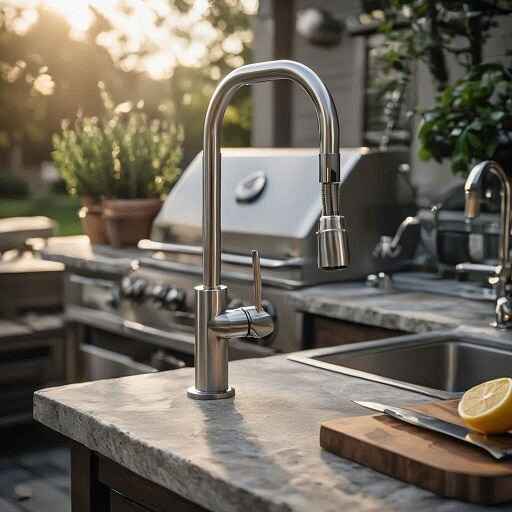
Setting up an outdoor kitchen is one of the best ways to level up your backyard entertaining game. But here is something most people overlook until it is too late: your faucet choice matters just as much as your grill or countertop. A regular indoor faucet won’t cut it outdoors, and trust me, finding out the hard way means dealing with rust, leaks, and replacement headaches you definitely don’t want.
The right outdoor kitchen faucet needs to handle rain, snow, UV rays, temperature swings, and constant exposure to the elements without breaking down. Whether you are rinsing vegetables, filling pots, or cleaning up after a backyard BBQ, you need a faucet that is built tough and looks good doing it.
In this guide, I’ll walk you through everything you need to know about choosing the best outdoor kitchen faucet for your space, including my top picks for 2026, what features actually matter, and how to avoid the common mistakes that lead to costly repairs down the road.
Table of Contents
Why Outdoor Kitchen Faucets Are Different
You might be wondering: can’t I just use a regular kitchen faucet outside? Technically yes, but it is a recipe for disappointment. Outdoor kitchen faucets are specifically engineered to survive conditions that would destroy a standard indoor faucet within months.
Weather Exposure
Your outdoor faucet faces challenges no indoor fixture ever will. Direct sunlight, driving rain, humidity, freezing temperatures, and even salt air if you are near the coast all take their toll. UV rays can degrade plastic components and cause finishes to fade or peel. Water can seep into crevices and cause internal damage. Temperature fluctuations make materials expand and contract, weakening joints and seals over time.
A proper outdoor kitchen faucet uses weather-resistant materials throughout its construction, not just on visible surfaces. The internal components, O-rings, cartridges, and connections all need to withstand exposure that would quickly corrode or break down standard fixtures.
Rust Issues
This is the big one. Rust is not just ugly, it compromises the structural integrity of your faucet and can contaminate your water. Standard faucets often use materials that oxidize rapidly when exposed to moisture and oxygen outdoors.
The best outdoor kitchen faucets use 304-grade stainless steel, which contains chromium that forms a protective layer preventing rust. Cheaper alternatives might look fine initially but will show corrosion within a season or two. Once rust starts, it spreads quickly and there is no real fix except replacement.
Water Pressure & Durability
Outdoor faucets often need to handle higher flow rates than indoor fixtures. You are filling large pots, washing down grills, and maybe even connecting hoses for cleanup. The internal components need to manage this increased demand without leaking or losing pressure.
Durability also means the faucet can handle rougher use. Outdoor cooking tends to be more casual and high-energy than indoor meal prep. Your faucet might get bumped, turned on and off frequently, and used with dirty hands. It needs to take that abuse without loosening, breaking, or malfunctioning.
What to Look for in an Outdoor Kitchen Faucet
Not all outdoor kitchen faucets are created equal. Here are the key features that separate the great ones from the ones that’ll have you shopping for replacements next season.
Material: 304 Stainless Steel Is Your Friend
This is non-negotiable if you want longevity. 304-grade stainless steel is the gold standard for outdoor kitchen faucets because it resists corrosion, handles temperature extremes, and maintains its appearance for years.
Some manufacturers use 316 stainless steel, which is even better for coastal environments with salt exposure, but it is typically more expensive. Avoid faucets that are merely “stainless steel finished” or chrome-plated brass, as these will corrode from the inside out even if they look fine on the surface initially.
Check the product specifications carefully. A true stainless steel outdoor kitchen faucet should explicitly state the grade of steel used in both the body and the spout. If they are vague about materials, that is usually a red flag.
Finish: Brushed Beats Chrome Every Time
When it comes to finish, brushed or satin stainless steel is your best bet for outdoor use. It hides water spots, doesn’t show fingerprints as easily, and maintains its appearance better than polished chrome or other shiny finishes.
Chrome finishes might look sleek initially, but they are magnets for water spots and mineral deposits in outdoor settings. They also tend to show wear more quickly when exposed to the elements. Matte black finishes are trendy right now, but make sure they are powder-coated properly for outdoor use, or they’ll chip and fade.
Single Handle vs Pull-Down Designs
Single-handle outdoor kitchen faucets are popular because they are simple to operate, even with messy hands. You can adjust temperature and flow with one motion, which is convenient when you are juggling food prep and cooking.
Pull-down faucets add versatility by extending your reach and providing spray options. They are fantastic for rinsing vegetables, filling large pots, and cleaning your sink area. The trade-off is that they have more moving parts, which means more potential failure points. If you go with a pull-down design, make sure the hose and spray head are specifically rated for outdoor use with UV-resistant materials.
For an outdoor kitchen sink setup, a pull-down faucet pairs beautifully with the right sink configuration. If you are still planning your outdoor sink, check out this guide on the Best Outdoor Kitchen Sink for Small Backyards to make sure your faucet and sink work together seamlessly.
Freeze Resistance
If you live anywhere with winter weather, freeze resistance is crucial. Water left in your faucet lines can expand when frozen, cracking the fixture and creating expensive damage.
Look for outdoor kitchen faucets with drain valves or freeze-resistant designs that allow you to empty the lines completely before winter. Some models have built-in check valves that prevent water from sitting in the spout when the faucet is off. If your outdoor kitchen operates year-round in cold climates, consider adding insulated faucet covers or heat tape to your installation.
Best Outdoor Kitchen Faucets (2026)
Based on durability, features, and real-world performance, here are my top picks for outdoor kitchen faucets in 2026. These are placeholder recommendations to give you an idea of what to look for when shopping.
Best Overall: Alpine Series Pro 304 Commercial Faucet
Why it wins: This single-handle faucet combines professional-grade construction with practical features perfect for outdoor use. The 304 stainless steel body and ceramic disc cartridge provide leak-free performance for years. The high-arc spout gives you plenty of clearance for large pots, and the brushed finish hides water spots beautifully.
The Alpine Series includes a built-in freeze valve for winter preparation and handles up to 1.8 GPM flow rate. Installation is straightforward with standard US plumbing connections. At around $280, it is an investment that pays off in longevity and performance.
Best for: Home cooks who want reliability without compromise.
Best for Small Kitchens: Compact Stream Mini Outdoor Faucet
Why it is great: Limited counter space doesn’t mean you need to sacrifice quality. This compact design features a lower-profile spout that works perfectly in tight quarters while maintaining the same 304 stainless steel construction and weather resistance as full-size models.
The single-handle control is side-mounted to maximize clearance, and the overall footprint is 30% smaller than standard outdoor faucets. Despite the compact size, it still delivers 1.5 GPM flow rate. Priced around $195, it is perfect for smaller setups.
If you are working with limited space, you’ll also want to consider compact sink options. This article on Outdoor Kitchen Sink Cabinets covers space-saving configurations that pair perfectly with smaller faucets.
Best for: Small outdoor kitchens, bar areas, or prep stations.
Best Pull-Down: FlexSpray Outdoor Kitchen Faucet
Why it is worth it: For maximum versatility, this pull-down outdoor kitchen faucet delivers. The 20-inch retractable hose extends your reach across the sink area, and the three-function spray head switches between stream, spray, and pause modes.
The UV-resistant hose won’t crack or fade, and the magnetic docking system keeps the spray head secure when not in use. The all-stainless construction includes a weight attached to the hose to ensure smooth retraction. At $340, it is premium-priced but offers functionality that makes outdoor food prep significantly easier.
Best for: Serious outdoor cooks who need maximum flexibility.
Best Budget Option: EcoLine Outdoor Stainless Faucet
Why it is a smart buy: Quality outdoor faucets don’t have to break the bank. The EcoLine proves you can get genuine 304 stainless steel construction, a ceramic cartridge, and weather-resistant design for under $150.
You’ll sacrifice some features compared to premium models, the spout is shorter, and there is no pull-down functionality, but the core durability is solid. The finish isn’t quite as refined as pricier options, and installation hardware is basic but functional. For weekend warriors or secondary outdoor sinks, this is an excellent value.
Best for: Budget-conscious buyers who still want quality materials.
Most Durable: TitanForce Heavy-Duty Commercial Faucet
Why it lasts: Built like a tank, this commercial-grade outdoor kitchen faucet is designed for restaurants and catering operations but works beautifully in residential settings. The extra-thick 304 stainless steel body, reinforced spout, and commercial ceramic cartridge are rated for 500,000 cycles.
The pre-rinse style spray head delivers powerful cleaning performance, and the wall-mounted design frees up deck space. It is overkill for some applications, but if you cook outdoors constantly or run a small catering business from your backyard kitchen, the $425 price tag is justified by its virtually indestructible construction.
Best for: Heavy use, commercial applications, or the ultimate in durability.
Faucet Types for Outdoor Kitchens
Understanding the different mounting styles helps you choose the right outdoor kitchen sink faucet for your specific setup and plumbing configuration.
Deck-Mounted Faucets
These are the most common type, mounting directly to your countertop or sink with the faucet body sitting on the deck surface. They are relatively easy to install, work with standard sink configurations, and offer the widest selection of styles and features.
Deck-mounted outdoor kitchen faucets require a hole in your counter or sink, typically 1.5 inches in diameter. Make sure your outdoor countertop material can accommodate drilling without cracking. Natural stone, stainless steel, and marine-grade polymer all work well, while some tile installations may require special consideration.
Wall-Mounted Faucets
Wall-mounted designs attach to the wall behind your sink rather than to the counter or sink itself. This style frees up deck space and creates a cleaner look, especially in modern outdoor kitchen designs.
The main advantage is easier cleaning since there is no faucet base collecting grime on your counter. The challenge is that your water supply lines need to be routed through the wall, which requires more planning during construction or renovation. Wall-mounted faucets also limit how far from the wall your sink can sit, so measure carefully.
These work particularly well in outdoor bar setups or when paired with undermount sinks in stone or concrete counters.
Pre-Rinse Faucets
Borrowed from commercial kitchens, pre-rinse outdoor kitchen faucets feature a flexible hose with a powerful spray head, similar to what you would see in a restaurant dish room. They are incredibly functional for high-volume cooking and cleanup.
The high-pressure spray makes quick work of stuck-on food and can even help with tasks like washing vegetables or filling large containers quickly. Most pre-rinse faucets mount to the wall or deck and include a separate spring that guides the hose. They are larger and more industrial-looking than standard faucets, which may or may not fit your outdoor kitchen aesthetic.
Installation Tips
Getting your outdoor kitchen faucet installed correctly prevents problems down the road. Here is what you need to know.
Clearance Matters
Measure twice, install once. Check that your faucet spout height allows comfortable clearance for your largest pots and pans. Standard spout clearance is 8-10 inches, but if you regularly use tall stockpots outdoors, consider a higher-arc design with 12+ inches of clearance.
Also verify that pull-down faucets have enough room to extend fully without hitting your backsplash or countertop edges. Account for the arc of the spray head when pulled down and extended.
Water Lines
Your outdoor kitchen faucet needs a reliable water supply that meets local plumbing codes. Use outdoor-rated supply lines that can handle temperature fluctuations and UV exposure if any part of the line is exposed.
Install shut-off valves beneath your outdoor sink so you can turn off water to the faucet without affecting your home’s main supply. This makes maintenance easier and allows you to winterize your outdoor kitchen efficiently.
Consider installing a water filter or sediment trap before your outdoor faucet if you are on well water or have hard water issues. Sediment and minerals can clog aerators and damage internal components over time.
Drain Considerations
Don’t forget the other end of the equation. Your outdoor kitchen sink needs proper drainage, and your faucet location should position the water stream directly over the drain to minimize splashing and mess.
If you are installing the sink and faucet as part of a new outdoor kitchen, think through the entire drainage path including where wastewater will go and how you’ll prevent freezing in drain lines during winter months.
Cost of Outdoor Kitchen Faucets
Like most outdoor kitchen components, faucets come in a range of price points. Here is what to expect and what you get at each level.
Budget Range ($100-$180)
Entry-level outdoor kitchen faucets in this range typically offer basic functionality with genuine stainless steel construction. You’ll find simpler designs without pull-down features, shorter spouts, and minimal extra features like spray functions.
Build quality is adequate for occasional use, though finishes may not be as refined and internal components might not last as long as premium models. These are solid choices for secondary outdoor sinks, bar areas, or if you are on a tight budget but still want weather-resistant materials.
Mid-Range ($180-$320)
This sweet spot offers the best value for most homeowners. You’ll find high-quality 304 stainless steel construction, better finishes, pull-down options, and more durable internal components like ceramic disc cartridges.
Features like multiple spray patterns, magnetic docking for pull-down heads, and better warranty coverage become standard in this range. These outdoor kitchen faucets should last 10+ years with minimal maintenance in typical residential use.
Premium Range ($320-$500+)
Top-tier outdoor kitchen faucets offer commercial-grade construction, the most refined finishes, and features like industrial-strength spray heads, extra-long hoses, and advanced freeze protection.
You are paying for thicker materials, better machining, and components designed for heavy daily use. Unless you are a serious outdoor cooking enthusiast, run a business from your outdoor kitchen, or simply want the absolute best, mid-range options typically provide better value.
That said, premium faucets often include lifetime warranties that can justify the higher upfront cost if you plan to keep your outdoor kitchen for decades.
Final Verdict
Choosing the best outdoor kitchen faucet is not just about finding something that looks good with your outdoor design. It is about investing in a fixture that’ll stand up to weather, use, and time without constantly demanding attention or replacement.
A rust-free outdoor faucet is a small upgrade that prevents big maintenance issues later. Spending an extra $100-150 upfront for genuine 304 stainless steel construction instead of a chrome-finished alternative saves you from dealing with corrosion, leaks, and the hassle of faucet replacement in a year or two.
When you are comparing outdoor kitchen faucets, prioritize material quality over trendy features. A simple, well-built single-handle faucet made from solid stainless steel will outperform and outlast a feature-packed model made from inferior materials every single time.
Pay attention to the grade of stainless steel used, choose a finish that works in outdoor conditions, and make sure the internal components are designed for weather exposure. If you live in a climate with freezing winters, don’t skip freeze-protection features.
Whether you go with a straightforward deck-mounted model for simplicity, a pull-down design for versatility, or a commercial-style pre-rinse faucet for maximum functionality, the key is matching your choice to how you actually use your outdoor kitchen. Think about your cooking style, the types of cleanup you do, and how much abuse the faucet will realistically take.
Your outdoor kitchen faucet works harder than almost any other fixture in your backyard setup. Give it the respect it deserves by choosing quality materials and appropriate features for your climate and cooking style. The right faucet disappears into your routine, always working when you need it without demanding constant maintenance or worry.
Now get out there, pick the outdoor kitchen faucet that fits your needs and budget, and start enjoying your backyard kitchen the way it was meant to be used, without plumbing headaches getting in the way of great food and good times.